Since the last post, written in May 2008, there have been no submissions of news, events, announcements, or articles by any members.
There will be no more posts on this blog. However, the blog will remain here for visitors to enjoy (until Blogger.com "purges" it which they sometimes do with inactive blogs).
Monday, March 9, 2009


Tuesday, May 20, 2008
Desert Meditations online exhibit & newsletter
Greetings to everyone!
We hope this post finds you with wonderful tapestries in progress on your looms or an idea for one in the works!
The exhibit will be followed by the newsletter, which unfortunately will be very short as there were minimal submissions, and which will also be the last formal newsletter. Upon founding Desert Tapestry Weavers, we had envisioned the group's core focus to be a forum where all members shared their tapestries and their journeys in creating them. From the beginning, we knew we did not want the newsletters evolving to be written largely by us or to only represent the work of a small portion of the members. We had entertained very high hopes that member participation would assist in keeping the group dynamic and viable. With 36 members and 63 readers, the interest is definitely there, but sadly the participation has declined and is not enough to support the publishing of regular newsletters unless we both continue to give more of our time to fill in the gaps, which we cannot do.
The exhibit will be followed by the newsletter, which unfortunately will be very short as there were minimal submissions, and which will also be the last formal newsletter. Upon founding Desert Tapestry Weavers, we had envisioned the group's core focus to be a forum where all members shared their tapestries and their journeys in creating them. From the beginning, we knew we did not want the newsletters evolving to be written largely by us or to only represent the work of a small portion of the members. We had entertained very high hopes that member participation would assist in keeping the group dynamic and viable. With 36 members and 63 readers, the interest is definitely there, but sadly the participation has declined and is not enough to support the publishing of regular newsletters unless we both continue to give more of our time to fill in the gaps, which we cannot do.
We would like to extend very sincere thanks and gratitude to those members who did take the time to contribute over the last year and also to the members who submitted works for this exhibit. The Desert Tapestry Weavers site will remain "alive", but it will now function as a forum to announce news related to tapestry. Please feel free to submit news about exhibits, calls for entry, workshops, or publications and we will gladly post them. We would also like to create another "Link" section where we can post member's websites, so if you would like your website included, please send the address to us!
Enjoy this online exhibit of Desert Tapestry Weavers member's works. These tapestries embody in part what the phrase Desert Meditations signifies for each artist.
Lyn & Kathy P.
Desert Meditations
 Sandia Winter Sunset
Elizabeth J. Buckley
4 inches x 24 inches
wool on cotton warp
"Sandia Winter Sunset" is a study I wove in preparation for a commission for a private collector, who was visiting her daughter here in Albuquerque, New Mexico during the winter of 2007, when we actually had snow. The desert sunset light is amazing here in how it makes the land glow with colors shifting from watermelon to mauves and golden rust tones, bringing out the texture of the grasses. My client shared a number of walks with her daughter in the foothills of the Sandia mountains, which border the eastern edge of Albuquerque, and she wanted a tapestry to reflect not only the magical quality of shifting sunset light, but the strength and character of the mountain as well. As I have been weaving on this commission (to be 30" x 46" horizontal), I find myself engaged in an in-depth dialogue with this high desert mountain, as I describe in tapestry its shadows and cliffs, foothills and grasses.

Flow
Dorothy Clews
37cm x 17cm
2008
cotton, silk, viscose, banana paper
tapestry weaving; decomposition - sun, rain, earth, micro-organisms; time and stitch
Dorothy Clews
37cm x 17cm
2008
cotton, silk, viscose, banana paper
tapestry weaving; decomposition - sun, rain, earth, micro-organisms; time and stitch
I have always been interested in patterns and systems in the natural environment. Water moves through our lives, often unseen, like warp threads in a tapestry. Disrupt the natural pattern and something else happens, revealing unseen connections, threads and patterns.
“Flow” as a tapestry, spent much of it time under the soil evolving into something else, at one time it was under three feet of floodwater. Leaf litter and rootlets were entangled in the threads when it was dug up. It speaks of water that flows, changing as it moves from sky to earth, earth to plant, plant to animal, animal to human, human to artifact: a changing, evolving force that gives a hidden structure to life.
 Once There Was a River
Mary Rawcliffe Colton
41" x 70" (triptych, as hung)
2005
hand-dyed Churro wool
"Once There Was a River" is my commentary on the desert - and its limited water supply - being overwhelmed by too many people. I wove it as a triptych to indicate passage of time.
 CHACO VIEW
Karen Page Crislip
12" Square
wool, alpaca, silk
This tapestry was inspired by my first visit to Chaco Canyon and its pre-Columbian ruins of the Anasazi, the ancestors of modern Pueblo Indians. I was intrigued by the openings left in the ruins and the distant views, both real and imagined, from these rough portals.
wool, alpaca, silk
This tapestry was inspired by my first visit to Chaco Canyon and its pre-Columbian ruins of the Anasazi, the ancestors of modern Pueblo Indians. I was intrigued by the openings left in the ruins and the distant views, both real and imagined, from these rough portals.
 SACRED PLACE
Karen Page Crislip
12" Square
Hand-Dyed Wool
"Elsewhere the sky is the roof of the world; but here the earth was the floor of the sky." ~Willa Cather referring to the Four Corners region
All of Canyon De Chelly is sacred to the Navajo--including Spider Rock, the most dramatic geologic feature of the canyon, believed to be the birthplace of all weaving. My tapestry is of just one location at the bottom of the canyon--one small area full of natural symbols underlying the spirituality of the canyon as the source of an ancient people.
 Century Plant in Moonlight
Lany Eila
6"square
"Century Plant in Moonlight" is based on experiences during a recent trip to Big Bend [Texas].
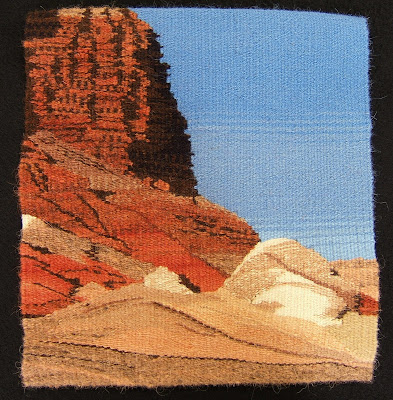 earth & sky
Lyn Hart
10” x 10.5”
november 2007
natural & synthetic dyed wools, cotton
This tapestry was inspired by a digital photo I took while my husband & I were hiking along the base of the Vermillion Cliffs during a trip to the Marble and Paria Canyon areas of northern Arizona. The beauty of the land here mesmerizes. While the elements of earth, air, fire and water are an integral part of every natural environment, it seems that in the deserts of the Southwest one can see, hear, smell, and taste the pure essence of these elements. Pared down to the essentials, these elements no longer exist as part of the landscape; they define the landscape, demanding unwavering attention of our senses.

WILDFLOWER MEADOW
Betty Headrick
approx 16” x 20”
two ply wool weft and cotton seine warp
This weaving is part of the “Harriet’s Challenge” project for the Tucson Handweavers and Spinners Guild. Last year Harriet Rein challenged guild members to create a project that reflected their love of the Arizona desert. Some of my favorite times in the desert are hikes with my husband and dog. The spring wildflowers were spectacular this year and gave opportunity for many wonderful hikes. While hiking my mind frequently “wanders” and projects and creative efforts find a seed among nature. It is also a time to find peace in my life among the many pressures of the world.
The colors of the flowers and the general shapes of the flowers were generated from photographs taken by my husband. I used the computer to identify the colors and to change the basic flower shape.

Shattered
Pam Hutley
4" x 13.75"
hand spun wool warp
hand spun wool, silk and mohair weft
all natural dyes
Land, and the country of my childhood. Eucalyptus forest country and thick Brigalow
scrub.
This same country is now under the development of the coal mining industry. The open cut method of mining creates deep canyons across the land, and within the canyons there is a deceptively narrow seam of coal visible.
The explosive material used to open the earth for mining the coal felt like
earthquakes. Our homestead would shake and rattle though we lived a great distance
away.
The black in my tapestry represents not only the seam of coal, it represents the
markings of the Richter scale, used to measure the magnitude of an earthquake.
The forests and scrubs are gone, the rich red and brown layers of topsoils separated
from the under layers of the earth, forever disturbed and shattered.
 Wild Wood II: Arizona sycamore
Kathy Perkins
43” x 10.5”
2007
hand dyed wool on cotton warp
I am in awe of trees, trees of all kinds, and have wanted over the years to do tree series. I
actually got the inspiration for the first of my trees while at the American Tapestry
Alliance 25th anniversary gathering in San Jose. I fell in love with a eucalyptus tree in
the median strip near the entry to San Jose State. I went home with my countless photos
and designed away. While still weaving that tapestry I decided the Arizona sycamore
should be the next in the series since I love their shapes, bark, and, especially their
environmental setting. Thus, I dug out all of my photos from my Arizona sojourns and
created this tree from a variety of trees from the past. While weaving both tapestries I
relived many experiences of adventure and exploration in which the trees were clearly a
prominent feature of the landscape.
DTW Newsletter
News
Canadian Tapestry Network
If you haven't checked the sidebar links on this site lately, you should! CTN now has a website up and running. Their latest newsletter is posted, along with a wonderful tapestry slideshow and links to resources.
http://www.canadiantapestrynetwork.com/index.html
Magpie Woodworks
John Jenkins, the wood artisan & owner of Magpie Woodworks, now has a website. He crafts beautiful custom tapestry forks with steel tines (you can even choose the tines per inch - tpi), needle cases, and other fiber related tools.
magpiewoodworksusa.com
Tapestry Blogs
These are noteworthy tapestry blogs... many of the weavers journal about their weaving, their design process, and post photos as the work is in progress. They hail from different parts of the globe, are a wonderful resource and very inspiring. How exciting to have opportunities to see tapestries as they are being woven and to be able to email a weaver to ask questions when something they are doing intrigues you! Make sure to check the links on each of these blogs when you visit them, they will lead to other tapestry & fiber art related sites that are awaiting exploration.
http://austintapestry.blogspot.com/
http://www.desertsongstudio.blogspot.com/
http://debbieherd.blogspot.com/
http://tapestry13.blogspot.com/
http://kspoeringtapestries.blogspot.com/
http://www.tapestry.co.nz/blog/
http://www.meabhwarburton.blogspot.com/
concealed, discovered, revealed
http://tapestry2008.blogspot.com/
Calls for Entry
Consider subscribing to the following blog to receive succinct news about calls for entry to fiber related exhibits--http://fiberartcalls.blogspot.com/
Weavings & Wanderings
Hot, dry and, very occasionally, wet
by Dorothy Clews
For the majority Australians the desert is – ‘out west’. For those who live ‘out west’ the real desert is always further on westwards. For the last few years, while living in Southwest Queensland, I have made brief forays in to the desert in the corner country of southwest Queensland, South Australia, and the Northern Territory.
The Simpson Desert is a land that is not what people expect. There is aridity, sand, clear blue-white skies, but there is also gibber plains, trees, food producing plants; even water, sometimes permanent, sometimes only after rain. And there is a record of thousands of years of habitation for those that can read the land and find that water.
Everywhere in the desert there are signs of water. In the dry, salty, cracked clay pans that occur in between each 140 km long parallel dune. The small occasional woodlands of stunted and twisted gidgee and coolibah search out water and survive in the dry periods. A waddi tree grove, one of three sites that have been found in Australia also records that somewhere deep in the earth there is enough moisture to support a few trees.
The desert is drained by five major rivers that cover one sixth of the continent flowing into Lake Eyre and other salt lakes. These rivers act as a refuge for wildlife, which spreads out into the desert during rain.
Once this area was an inland sea. There are clues to this past for those that know where to look. Bounding the somewhat less arid borders to the east and south east are ranges which hide bands of opal bearing rock- the boundary of the land and sea in the distant past. Opal which is 30% water. On the desert edges to the west and south there are mound springs which are like a giant release valve for the Great Artesian Basin, part of which is under the Simpson Desert. This network of springs has in the past provided a network of life support for animals as well as humans. Another source of water from the Basin is Purnie Springs a bore drilled for the oil exploration teams that opened up the desert tracks, and then later abandoned them. This bore (now controlled) runs into a small waterhole that supports wildlife and a welcome rest for travellers. A beautiful campsite with a hot shower, courtesy of the naturally heated fossilised water that comes from deep underground.
A pulse of life goes through the country after major rains. To see tyre tracks filled with brilliant small flowers, as flowing water filled them a few weeks earlier is a magical sight. This pulse is repeated on a cosmic scale. The desert landscape is stacked in time. Every hundred thousand years there are glacial/interglacial cycles with the country becoming wetter or dryer with the general trend to increasing aridity. These pulses are like a beating heart that is slowly running down with the warming of the planet.
Over the last two years I have worked with the theme of water, and the lack of it, salt, clay and sand, resulting in twelve small tapestries that reflect the arid landscape of Southwest Queensland in particular the two gardens I have established first in Charleville and later in St George.
‘Pulse’ was planted in our St George garden last August around the time it rained for the first rain in months. It took a while to start decomposing, but the waterhole in front of our house had actually received some water and we were able to water our gardens again.
One of the most magical sounds I have heard is the sound of the water coming down a dry creek bed after 7 years of drought - small rippling sounds, gurgles, sucks and splats as
it flowed down the dried out cracks in the riverbed and over the surface. You could hear the dry earth drinking it up.
It was after this I began the stitching of ‘Pulse’ in December, a lot more rain had fallen, and the river was flowing as I stitched. The unraveled threads and the woven remains developed a rhythm of their own reflecting the rise and fall of the town waterhole as upstream rain flowed down, water was harvested by irrigators for the first time in a couple of years, and environmental flows were allowed to flow on down the system.

Pulse in progress

Pulse detail
Pulse unwashed
Pulse washed detail
Recommended reading:
‘Dune is a four letter word’ by Griselda Sprigg for a mother’s view of the first crossing of the desert by car.
Links:
Desert
http://www.nma.gov.au/research/centre_for_historical_research/the_centres_projects/into_the_desert/
Research on the Simpson Desert with good images
http://www.worldwildlife.org/wildworld/profiles/terrestrial/aa/aa1308_full.html
Research on the Simpson Desert
http://www.abc.net.au/rn/hindsight/features/landscape/default.htm
ABC program interviewing people who live or work in the Central Desert.
Tapestry
http://www.americantapestryalliance.org/Members/NLv32n2/NLv32n2p2.html http://www.americantapestryalliance.org/phpBB2/viewtopic.php?t=344 http://www.americantapestryalliance.org//Exhibitions/FindingHomeExh/FindingHome.html
Mary Rawcliffe Colton
A weaver since the early 1970’s, I began in the New England tradition of pattern weaves and clothing. However, a St. Louis neighbor was Muriel Nezhnie who made certain that local weavers were exposed to tapestry, and an early success came when Francis Merritt, then Director of Haystack, awarded a prize for my tapestry mask and encouraged me to attend Haystack.
During the 1980’s and 1990’s in Albuquerque I wove Ikat garments and wall hangings in a Collingwood technique called “clasped weft,” both faster and easier to sell than tapestry. For most of the 1990’s I was the adjunct weaving instructor in the Art Education Department of the University of NM, addressing all the basic techniques and all the beginning questions of weaving. With retirement in sight and a need to check my range of weaving skills, I earned HGA’s Basic Level Certificate of Excellence in 1996. For my Master’s Level I focused on the technical choices a tapestry weaver has to make, including a study of techniques used in a number of cultures around the world. I earned that COE in 1998 and retired from regular teaching in 1999.
Since then I have critiqued with a number of tapestry friends and worked on the development of an active tapestry group in Albuquerque’s Las Aranas Spinners and Weavers Guild. Presently that group has woven more than 50 small tapestries for a “Doors, Gates and Windows” challenge with the Vancouver Island tapestry weavers; half of those tapestries will be shown in the ATA small format exhibit (Woven Gems) at Convergence. The full show will hang at First Unitarian Church in Albuquerque, 9/7/08 to 10/18/08.
With training both in English teaching and biology, I look to poetry and to the natural world for inspiration. My triptych “Once There Was a River” [in the online exhibit] is a visual commentary on the high desert’s being overwhelmed by too many people.
Pam Hutley
Mackay QLD
I have been a tapestry weaver for many years, developing my style as a designer and weaver as I developed the hand spun and natural dyed yarns I weave with. I am a pictorial tapestry weaver, but now and then I step aside from this way of weaving to explore other ways to express my thoughts. [See Pam's tapestry, Shattered, above in the online exhibit]
Workshops
Natural Dye Workshop
August 8-10, 2008
Jane Hoffman's Blue River Wilderness Retreat, AZ
Accommodations:
Available in Alpine, Arizona, National Forest campgrounds and at Jane and Don's Blue River Wilderness Retreat.
Skill Level:
Beginning and Intermediate
Description:
This 2 1/2 day comprehensive workshop shows you how to create a rich palette of beautiful, lightfast and washfast color from natural dyes. We will be using native, cultivated, and imported dye material including plants from Jane's dye garden. She will share her knowledge and methods for producing many shades of color from each dye-pot. You will learn to prepare the dye, to mordant and dye protein fiber (i.e. wool, silk, mohair, alpaca), and to experiment with color by using post-mordant baths, exhaust baths and over-dyeing.
Class fees dependent upon number of participants:
4 = $240; 5 = $192; 6 = $160; 7 = $138; 8 = $120; 9 = $107; 10= $96
Materials:
Materials will be provided (materials fee: $25)
Contact:
Jane Hoffman j.hoffman@frontiernet.net or Sandy Gally 928-445-1499 or sbgally@hotmail.com
("I have taken several dye workshops and none can compare to Jane's workshop. I learned more in her workshop than all the others put together. On top of that her folder of instructions, recipes and information are second to none; and we get to keep the folder. It has been said that natural dyeing is not color or washfast.. Her natural dye tapestries prove otherwise. And one could not ask for a more beautiful setting. If you need more encouragement, give me a call or e-mail me." -Sandy Gally)
http://www.blueriverretreat.com/
www.artistsregister.com/artists/AZ104
Habu Textiles lecture, workshop and trunk show
October 21st 2008, 9:00 am- 4:00pm
Come see, feel, and learn how to use Habu's unusual yarns and fibers during their one day visit to the Desert Weaving Workshop. Habu carries unusual and difficult to find fine yarns from Japan and Asia for weavers, knitters, basket makers, stitchers, and artists. Naturally gold colored silk, raw and degummed bombyx silk as fine as 42 denier and up, hand reeled raw and degummed Akagi silks, extra fine silk, wool, cotton or wool/cashmere crepe, hand-tied ramie banana "basho", bamboo, silk & wool stainless steel, paper, hemp bark, etc. are only a few of over 300 selections we have. We offer some special equipment and also "rodin" silk degumming powder.
To register, visit the Desert Weaving Workshop website.
COLOR AND DESIGN FOR CONTEMPORARY TAPESTRY
with James Koehler
February 7-11, 2009, Saturday through Wednesday, 9:00 am – 5:00 pm
Desert Weaving Workshop, Tucson, AZ
This workshop is a continuation of study begun in Color and Design I. Exercises in design will include symbolism & the design principles of Form; grid structures, tilings & fractals; and the pliable plane. Color study will focus on the Goethe color system and various optical effects of color. There will be opportunity to weave up to three miniature tapestries based on the design and color exercises. Participants should have basic knowledge of tapestry weaving. Color and Design I is not necessarily a prerequisite.
COST: $400. Register before Jan 1 and save $25.
A $25 materials fee will provide for warp and weft and a folder of handouts.
Scholarships may be available. Let us know if you are interested.
To register, visit the Desert Weaving Workshop website.
Media
 Natural Dyes: Sources, Tradition, Technology and Science
by Dominique Cardon
September 2007
ISBN-10: 190498200X
ISBN-13: 978-1904982005
This authoritative resource is an expanded, corrected and updated translation of the award -winning book Le Monde des Teintures Naturelles published in 2003 in Paris. To my knowledge, this is the most comprehensive book on natural dyeing currently available. If you are a natural dyer and want to have at your fingertips every scrap of info, including history and chemical structure of the dyes, there is no other book that will give you that kind of info in this depth. A hefty text, it contains an unbelievable amount of content. Dyes are categorized by color, the pictures are outstanding, and it is very enjoyable to read, not dry and boring like many other "technical" manuals. The bibliography alone is worth its weight in gold. Expect to pay close to $200US for this book, but it is worth the cost!
 Artists Tapestries from Australia 1976-2005
by Sue Walker
October 2007
ISBN-13: 9780947349509
ISBN: 0947349502
find it at Booktopia.com
The story of the Victorian Tapestry workshop from its formation to 2005. It details not only the pioneering interaction of the Workshop with aboriginal artists but also how the VTW promoted collaborations with noted artists of the times, acting as a springboard that raised tapestry to become considered an accepted, respected, and treasured art form in Australian. The photos are to die for, with many, many wonderful close ups of weave structure and also "historic" photos from the VTW's early years. The ultimate "coffee table" book for all tapestry weavers! Also a very large, pricey text, the best price may be found at the Australian website listed above.
(reviews by Lyn)
Happy Weaving!
Tuesday, April 1, 2008
Ramses Wissa Wassef Art Centre Petition – A Thank You

The petition launched in January 2008 on behalf of the Ramses Wissa Wassef Art Centre calling on the Egyptian authorities to take action against the rising ground water table that has greatly damaged the adobe buildings of the Art Centre has had an encouragingly positive outcome.
The petition was organised by The Ramses Wissa Wassef Exhibition Trust, London and signed by some 1700 people from many different countries. It was presented to the Governor of Giza in mid-March. Plans made by the authorities to cover the drainage canal that was causing the devastation were given top priority. Construction work has begun and it is expected that most of the problems will be eliminated by the end of April. Renovation work to restore the buildings of the Art Centre will begin in the summer.
The Wissa Wassef family wish to thank the Governor of Giza and the irrigation and drainage departments for the swift action and most particularly to thank all who signed the petition for your most valuable support.
Ikram Nosshi
Ramses Wissa Wassef Art Centre
Barbara Heller
Ramses Wissa Wassef Exhibition Trust London
http://www.wissa-wassef-arts.com/intro.htm
Friday, March 21, 2008
Fall 2008 Textile offering at Penland School of Crafts, Penland, NC, USA

Tapestry and Creative Potential
September 21-November 14, 2008
Instructors:
Peggy McBride, Tommye Scanlin, and Pat Williams
Tapestry weaving techniques are easy to learn yet often take a long time to master. Along the way to mastery, there are many roads to consider in methods and in design ideas. This class will be about both: the known paths to basics of tapestry technique and the creative meanderings where ideas develop. Collaborations among teachers and students will encourage all to delve into sequence and resolution, tradition and innovation. We will explore ways to find and develop personal concepts and images through which to celebrate the nature of tapestry. Instructors McBride, Scanlin and Williams are long-time friends in fiber; over the past twenty-five years they've worked together in fiber art guilds, workshops, and critique sessions. They are eager to share ideas with others during this eight-week session at Penland, one of the most exciting craft schools in the U.S.
Brief bios:
Peggy McBride
Mixed media artist (commissions: Atlanta's Alliance TheatreCompany, Children's Hospital, Federal Reserve Bank); owner, Globe Galleryin Clayton, GA; grants administrator for state's Grassroots Arts Program; creative consultant for non-profit art organizations.
Tommye Scanlin
Studio artist; juried member Southern Highland Craft Guildand Piedmont Craftsmen; professor emerita of art, North GA College & StateUniv (GA); other teaching at John Campbell Folk School, Penland (NC), Arrowmont (TN); American Tapestry Alliance award (2007); works included in several public and private collections.
Pat Williams
Studio artist; juried member Southern Highland Craft Guild; Masters in Art Education; art teacher of fifteen years (public school); American Tapestry Alliance award (2006); exhibited nationally and internationally with tapestry works in private collections.
For more information: http://penland.org/
Tuesday, February 26, 2008
Workshop Announcement
 Tapestry Workshop by Jane Hoffman
Place:
Waugh Mountain Alpacas
Nutrioso, Arizona
Date:
Waugh Mountain Alpacas
Nutrioso, Arizona
Date:
Saturday, August 23, 8:00am to 5:00pm
Sunday, August 24, 8:00 am to 3:00 pm
Skill Level:
Beginning and Intermediate
Description:
Description:
Participants--
-will investigate the art of tapestry by learning tapestry techniques.
-weave a sampler using basic tapestry techniques.
-explore the quality of texture by incorporating a variety of fibers in their sampler.
-will investigate the art of tapestry by learning tapestry techniques.
-weave a sampler using basic tapestry techniques.
-explore the quality of texture by incorporating a variety of fibers in their sampler.
Workshop can include the following:
-warping
-design methods for planning a tapestry.
-slide show
-finishing, blocking, and mounting tapestries
$175 per person - includes breakfast and lunch both days and a tapestry loom for you to keep. Kids 12 yrs and older are welcome (cost for kids is the same to cover materials and food)No special skills or prior experience are needed!
Breakfast and lunch will be served both days of the workshop.
Yarn will be supplied by Jane Hoffman & Waugh Mountain.
The workshop will be at Waugh Mountain Ranch which is located on the east side of Hwy. 180 in Nutrioso, Arizona; just south of mile marker 414 (across from the transfer station)
Breakfast and lunch will be served both days of the workshop.
Yarn will be supplied by Jane Hoffman & Waugh Mountain.
The workshop will be at Waugh Mountain Ranch which is located on the east side of Hwy. 180 in Nutrioso, Arizona; just south of mile marker 414 (across from the transfer station)
Visit this link for more info & registration form!
contact:
928-339-4244
http://us.f593.mail.yahoo.com/ym/Compose?To=fillipi@cybertrails.com
http://www.waughmtnalpacas.com/
Jane Hoffman, Blue River Studio
j.hoffman@frontiernet.net
j.hoffman@frontiernet.net
Monday, February 11, 2008
Desert Meditations exhibit deadline reminder!
Greetings to all!

Seasons are changing in both hemispheres of our beautiful planet, and the time is quickly approaching for Desert Tapestry Weavers' 1st year anniversary and our first members' online exhibit!
This is a reminder for all members... please consider entering a work that represents your interpretation of the theme Desert Meditations. Also, our first newsletter of the year will be published at the same time, so please consider submitting an article... introduce yourself if you haven't already; let us have a peek of what's on your looms, what you just cut off, or what you are planning; if you don't have a tapestry to submit for the exhibit write about your desert meditations to inspire all of us!
Here are the details again:
The show’s title, Desert Meditations, was selected because it is inclusive of all things desert. Whether you interpret it as a specific thing or place, or as an abstract tapestry reflecting a mood or sense of place, it does not matter. All entries are welcomed.
Format:
~jpeg or gif format (include file name in your email, please!)
~name and size of tapestry, plus materials used
Some specifics:
~all entries will be accepted
~there is no size constraint
~there is no size constraint
~the work can be current or from the past
~include a short statement (200 words or less) about the tapestry
Deadline:
Files are due to Lyn (desertsonghart@yahoo.com) by May 1, 2008 so the show can be posted by our first anniversary, May 22, 2008.
Happy weaving, everyone!
Tuesday, February 5, 2008

Tohono Chul Park is seeking submissions by Southwest artists for an upcoming exhibit:
Artful Insects and Inspired Arachnids
May 22 – August 17, 2008
Free Artists’ Reception: Thursday, May 22, 5:30 – 7:30pm
Artful Insects and Inspired Arachnids
May 22 – August 17, 2008
Free Artists’ Reception: Thursday, May 22, 5:30 – 7:30pm

We are surrounded by a universe of fluttering moths and butterflies, hovering dragonflies and honey bees, industrious harvester ants and paper wasps, lacy web-making spiders, and a plethora of other insects. Quite simply, as we hustle about our daily routines, we often do not notice the various bugs and spiders that are denizens of our environment. Perhaps they get our attention when we get bitten by one or when they have munched the leaves in our garden. And yet, if we take a closer look at the complex beauty of the six- and eight-legged critters—their artful camouflage, their delicate, iridescent wings—and the various roles they play—as they pollinate plants which feed the planet and loosen and fertilize the soil-- we may gain a greater appreciation of these diminutive creatures.
This group exhibit will focus on a wide range of paintings, drawings, jewelry and beadwork, works in clay, fiber, metals, mixed media, and photography inspired by the insects, spiders and creepy crawlies primarily from our region. From realistic renderings to artful fancy, the diversity of artworks helps us all to be aware of and look a little closer at the tiniest creatures in our world and see them a little differently.
Tohono Chul Park, where nature, art and culture connect, is a not-for-profit organization located in a residential setting in northwest Tucson. The Park is a 49-acre desert garden with a charming 75 year-old restored adobe building providing space for changing displays. It has an active art and cultural exhibits program and a family-oriented audience. Gallery hours are 9:00 am-5:00 pm daily. Our website is http://www.tohonochulpark.org/.
Submissions accepted: through April 8, 2008; No Entry Fee; No limit on number of works that can be submitted.
Slides, photos or CDs of completed work may be submitted by mail to: (Please include SASE)
Vicki Donkersley, Curator of Exhibitions
Tohono Chul Park, 7366 N. Paseo del Norte, Tucson, AZ 85704
Or digital entries will be accepted by email to: vickidonkersley@tohonochulpark.org
Please print the form below and mail with your entries or reproduce the form and send digitally.
Entry Form
Artist’s Name:_____________________________
Address:_________________________________
City/State/Zip:____________________________
Phone: (_____)______________ email:_________________
Submitted by: Mail______________ Email___________ Date submitted_________
Type of Media submitted: Slides_________ Photos__________ CD_________
Phone: (_____)______________ email:_________________
Submitted by: Mail______________ Email___________ Date submitted_________
Type of Media submitted: Slides_________ Photos__________ CD_________
Digital__________
Number of entries: ___________
Number of entries: ___________
Title: ________________
No. Images: ___________
Medium: _____________
Size (H x W x D): _______
Please include short statement about your work as it relates to the theme of the exhibit with your entry form.
Checklist:
Entry form
Slides or photos identified with artist name and title/or jpegs on a single CD
A self-addressed, stamped envelope with enough postage for return of mailed materials
Short statement about the work as it relates to the theme
Questions:
Contact Vicki Donkersley, 520 742-6455 x218
or email: vickidonkersley@tohonochulpark.org
If works are offered for sale, Tohono Chul pays artist 60% and keeps $40% commission. Works do not have to be for sale. Sales are handled through the Museum Shop. All work must remain on display until the end of the exhibit. Work is insured while on display at the Park.
Monday, February 4, 2008
Artists Call to PEACE
Inspired by collaborative projects like the Aids Memorial Quilt and Sonya Clark’s Beaded Prayers Project, we invite you to help create the “Countdown to PEACE.” Presented in calendar format, the project will begin with March 19, 2003 (the day the war in Iraq began) and will end when the war ends. At this point we are into the fifth year of the war; the calendar format allows us a way to measure the full extent of the war and gives us a visual sense of its continuing scope.

tapestry woven by DTW member Lyn Hart was used for the first exhibit postcard
CRITERIA
Each calendar month will be its own presentation board made up of 4-inch squares, 7 across and 5-6 rows down. Each entry will represent one day of this war. We are inviting artists to send us entries that are no larger than 4-inches square, no deeper than l inch, and no heavier than 2 pounds. Limiting size will make display feasible. Work that is included in this project will become the property of the project. The entries will be permanently attached to the “calendar” pages for ease of transporting.
Any media is acceptable. Remember that since only one side of the work will be seen, 2-D approaches are preferred, however clay or metal works done in relief (for example) will also be accepted. Please adhere photographic images or paper entries to foam core or cardboard cut to size. And with all entries, please indicate the TOP of the work.
We intend for the project to be POSITIVE in nature. We are mainly interested in your personal VISION OF PEACE. Please do not use imagery and/or text that is specific to any government officials or policies. Please keep the focus on PROMOTING PEACE rather than on decrying war.
Entries that do not meet the criteria in terms of size or content will be returned to the sender.
WHAT TO DO
Download the Entry Form (PDF), print and fill out all information requested. Send your work, along with $10. PER ENTRY; the entry fee is non-refundable. Make checks payable to “Countdown to Peace.”
Mail your entry and check to:
Countdown to Peace, PO Box 145, Ayden, NC 28513
Money collected from the entry fees will be used STRICTLY to defray the costs of display materials, promotional information, shipping, and insurance.
Our website: http://pages.suddenlink.net/w2la_design/peace/index.htm is up and running. It will provide information on current developments and will also give participating artists a link to their websites. Our first exhibit was November 2007 at the Mendenhall Gallery on the campus of East Carolina University. Included in the exhibits will be 1. an alphabetical listing of all contributors with the day, month, and year where each entry is displayed and 2. a chronological listing of entries along with artist’s name.
Wednesday, January 9, 2008
Happy New Year to All!

Please take a few minutes of your time to read the following message about the Ramses Wissa Wassef Art Centre that was forwarded to us by Barbara Heller in Vancouver, B.C., Canada. Also, please note that the Barbara Heller who wrote this is not the same person as Barbara in Canada!
URGENT
To all friends of the Ramses Wissa Wassef Art Centre:
I am writing to you as I know you will be concerned to learn that the survival of the Art Centre in Harrania, for whose adobe workshops and galleries Ramses Wissa Wassef won the Aga Khan Award for Architecture in 1983, is seriously threatened by rising water.
To view dramatic photographs and to read a report about the damage please visit www.wissa-wassef-arts.com/petition.html
The trustees of the Ramses Wissa Wassef Exhibition Trust, a charity registered in the United Kingdom which in 1985/86 and 2006 organised a series of highly successfully exhibitions of the tapestries in the UK, plan to present a petition to the Governor of Giza and other authorities in Egypt.
Please lend your support to this call for urgent action to ensure the survival of the Art Centre and of the tapestry weaving experiment which continues to delight and inspire thousands of people thoughout the world. Any further help you can give by urging friends and colleagues to sign the petition would be greatly appreciated. All signatures will be added to the 300 collected at the recent exhibition of new tapestries for sale held in London at the end of 2007.
Barbara Heller, Trustee & Secretary of the Ramses Wissa Wassef Exhibition Trust
Please sign the on-line petition by 10th February 2008 at
http://www.gopetition.com/petitions/on-behalf-of-the-ramses-wissa-wassef-art-centre-egypt.html
Sunday, October 28, 2007
Update: Conferences, Calls for Entry, & Workshops in Australia & Tucson, AZ
 alpacas grazing in Sonoita, AZ
Fibers Through Time 2008: Connections With the Past
April 3 - 6, 2008
Tucson, AZ
Sponsored by: Arizona Federation of Weavers & Spinners Guilds, Inc.
Sponsored by: Arizona Federation of Weavers & Spinners Guilds, Inc.
Our Board of Directors and Conference Committee are delighted to bring you Fibers Through Time 2008. Because of scheduling conflicts at the Central Arizona College, we have moved our Fifth Biennial Conference to a new site – the Holiday Inn Palo Verde in Tucson, Arizona.
We will celebrate our Connections with the Past by sharing old traditions including historic patterns in the center pieces and scarves, and learning more about the history of fibers grown in our area from our keynote speaker, Dr. Glenna Dean, as she talks with us about the Archeology of Cotton.
Please join us in learning more about our crafts and their connections to the past and be inspired to stretch our abilities and imaginations to plan for future endeavors.
Elaine Ross, President
Keynote Speaker
Glenna Dean, Ph.D.
Dr. Glenna Dean's fascination with archaeology was sparked by 1950's National Geographics and her mother's few recollections of her own grandmother's Cherokee childhood. Glenna acted on this fascination by beginning her college archaeological field school the week after graduating from high school. Glenna says “I guess I was born curious about the past – I’ve been fascinated by how people lived in the past ever since I learned to read. I’ve always wanted to be able to experience first-hand what I’ve read about too, so I learned to spin and weave and dye yarns and make clothes and tan hides and all kinds of things. I love touching the past, whether it be an artifact or the pollen grains left in a pot from cooking supper a thousand years ago.”
Holding graduate degrees in archaeology and botany, Glenna specializes in archaeobotany, the study of people's interactions with plants as revealed in charred seeds, broken plant parts, pollen grains, basketry, sandals, and other textiles made of plant fibers. She came to the Historic Preservation Division, part of the Department of Cultural Affairs, State of New Mexico in 1994 and became the New Mexico State Archaeologist in October 1997. Her job is largely public outreach, meaning that she gives talks to groups, writes articles for publication, helps get important archaeological sites listed on the State Register of Cultural Property and the National Register of Historic Places, and stages the New Mexico Archaeology Fair in a different small town every year. She also works with the Office of the Medical Investigator, law enforcement officers and Indian tribes on the best things to do after human bones are accidentally discovered by hikers or during construction.
“The Archaeology of Cotton”, her keynote topic, seems straightforward enough: cotton was grown by Ancestral Puebloans in New Mexico and Arizona before the advent of Columbus. Spanish explorers remarked on the cotton fields lining the Rio Grande in the 16 and 17 centuries before sheep and wool c th th ompletely replaced the native crop. Cotton is the “natural” fiber of choice in today’s society. What’s the big deal? Prepare to be entertained and enlightened!
Juror’s Choice Exhibit
Claire Campbell Park, Juror
Claire Campbell Park is an artist, lecturer and curator. Her interests include color, fiber, mixed media, sculpture, weaving, basketry and cultural diversity. She received an M.F.A. from UCLA in 1978, and immediately became Head of the Color and Fiber areas at Pima Community College in Tucson, Arizona. Pima Community College is the nation’s eighth largest community college with 75,000 students. Teaching at Pima Community College has given Claire the opportunity to work with thousands of students from extremely varied geographical, cultural, economic, vocational and educational backgrounds and this has led to a creative philosophy that is both inspiring and accessible to a broad audience.
Claire exhibits and lectures nationally and internationally. Exhibits include “Made in California 1900-2000: Art, Image and Identity” Los Angeles County Museum of Art, “The Twelfth International Biennial of Miniature Textiles” Szombathely, Hungary and “The International Textile Competition” Kyoto, Japan. Lecture venues include the Louvre and Ecole Nationale Sup6rieure des Arts D6coratifs, Paris; Seian College of Art, Kyoto; Apeejay College of Fine Arts, Jalandhar, India; and the University of South Australia, Adelaide. Claire researched Moroccan textiles and served as an exhibit consultant for the Textile Museum in Washington, D.C.
Claire also leads retreats and workshops on Creativity, Culture and Spirituality - most recently for the Newman Center at the University of Arizona, and on Seeing Color and Light for the Arizona-Sonora Desert Museum.
Conference Schedule
Thursday, April 3
Pre-conference tours
Wine and Cheese Party 6:30 to 8:30 pm
(transportation provided)
Registration 1:00 to 7:00 pm
Friday, April 4
Workshops 8:30 to 11:30 am
Vendors 11:00 to 5:00 pm
Workshops 1:00 to 4:00 pm
Vendors 7:30 to 9:00 pm
Dinner 5:30 pm
Keynote Speaker
Saturday, April 5
Workshops 8:30 to 11:30 am
Vendors 11:00 to 5:00 pm
Workshops 1:00 to 4:00 pm
Vendors 7:30 to 9:00 pm
Dinner 5:30 pm
Awards
Sunday, April 6
Workshop visitation 8:00 to 9:00 am
Workshops 9:00 to 12:00 pm
Vendors 10:00 a.m. to close
Juror’s Choice Exhibit will be open during lunch breaks Friday, Saturday and Sunday, one hour before the start of morning workshops Saturday and Sunday and Friday and Saturday evenings from 5:00 to 9:00 PM. Volunteers will monitor the gallery during these times. Participants must deliver their entries to the Barcelona room off the main lobby no later than Friday morning at 8:00AM. All entries must be picked up at 1:00PM on Sunday.
For complete information regarding the conference, visit the Arizona Federation of Weavers & Spinners Guilds website to view a downloadable version of the registration booklet. You do not need to be a member of an Arizona guild to register!
 custom tapestry forks by John Jenkins of Magpie Woodworks
TAPESTRY 2008: The Fine Art of Weaving
April - May, 2008
Australia
Contemporary woven tapestry's rich colours, strong images, tactile and malleable surfaces, range of scale from small to monumental, and handcrafted expertise, make it an exciting artistic medium. It possesses a powerful physical presence and is able to impart permanence through its timeless qualities together with images relevant to the modern world.
It has a short history in Australia, developed through the contemporary craft movement, community tapestry projects, the Victorian Tapestry Workshop and other artists and arts organizations. The main influences here are from European traditions dating back to the medieval period. In the Renaissance, Raphael's tapestry cartoons depicting the “Acts of the Apostles” established a close relationship between teams of tapestry artisans and painters. This way of working continued through to William Morris who brought about changes in design for tapestry, refined the use of colour and reinstated tapestry as an art form of its own right. French painter Jean Lurcat and Scottish master weaver Archie Brennan then developed and shaped the European and related North American and Australian movements in the 20thC. However other models for tapestry production exist in Scandinavia, South America, the Middle East and Asia where images intrinsically linked to the warp and weft structure are produced, with no reference to painting. In these cultures tapestry is firmly part of weaving culture. This project highlights the global diversity of tapestry and the exciting new developments in relation to weaving/Fine Art. The aim is to increase a wider understanding, create awareness and appreciation, encourage critical debate and provide alternative models for artists to develop. Through this stimulation tapestry can continue to evolve into relevant forms for the future.
THE PROGRAM – 2 APRIL-7 MAY 2008, Canberra, Australia
“TAPESTRY 2008” builds on the momentum of previous events in Australia and overseas and explores the relationships between visual art, tapestry and the craft of weaving, internationally. It brings together weavers in the community, professional practitioners, educators, students, collectors, critics, theorists and historians from around the world for exchange of ideas, interaction, practical learning, exposure to new works and informed debate. The conference stimulates critical discussion and the program of exhibitions, focussed talks with tapestries in collections and institutions including National Gallery of Australia, Parliament House, Department of Foreign Affairs plus practical workshops and seminars reaches a wide audience and provides development opportunities for artists.
The Conference – Friday 2- Saturday 3 May 2008, The Australian National University, School of Art.
Papers presented on tapestry and its relationship to art/weaving to investigate and seek solutions to issues of originality, creative content, authenticity and appropriateness of design process with a view to developing the art practice. Themes addressed include but are not restricted to:
Sharing experiences and the relationship of the artist/weaver to tapestry
Investigations of the techniques of weaving and tapestry cross-culturally
Community engagement with tapestry to create a sustainable and relevant future
Increasing the profile - collectors, the patron and tapestry for public places
Cultural diversity – tapestry from specific cultural traditions
Engaging with new technologies and applications - contemporary developments/perspectives
Creating greater income for artists through design, collaboration, industry involvement
Creative marketing, web profile and raising public awareness
Producing opportunities for international exposure and commissions
Master classes and Seminar Program – 30 April – 7 May
Workshops with leading professional artists to investigate approaches to technique/design/image-making including 3-hour seminars on developing professional skills and running a community tapestry project.
Exhibition Program – 2 April – 4 May
Lao PDR Tapestry: “Weaving Dreams and Aspirations”
ANU, School of Art Foyer
Fine silk tapestries from the rich artistic tradition of Laos where the weaver works directly at the loom creating a composition of patterns, symbols and motifs. She invests her life in the fabric and it tells of her hopes, dreams, ambitions, sense of self and position in the world.
“The Fine Art of Tapestry Weaving”
School of Art Gallery
Aino Kajaniemi, Finland, Susan Mowatt, Scotland, Yasuko Fujino, Japan, Sue Lawty, GB, Sara Lindsay, Australia, Jane Kidd, Canada and Fiona Rutherford, GB.
“LAND”
The Tapestry Foundation of Victoria Open Entry International Award Exhibition to encourage emerging artists and recognise professional artists.
“En Pleine Air Tapestries - A Month at Bundanon: Tapestries and Drawings by Cresside Collette”
curated by Alison French, at the Drill Hall Gallery, Canberra.
There will be focussed talks at public venues displaying tapestries in Canberra .
ARTISTIC BENEFITS and OUTCOME
The program will take place 20 years on from the International Tapestry Symposium, held in Melbourne in 1988. This previous event was the first truly global event of its kind in the world and the impact was far-reaching. In the last two decades there have been considerable changes that have impacted on the field in a range of arenas including economies, interest in minority/traditional/sustainable cultures, directions of art/architecture/design to the exploding world of technology. What place has tapestry now? Finding the answers to this question is crucial for the dynamic future of this art form. The program for TAPESTRY 2008 has been carefully considered and designed to address the emerging issues and to seek solutions. As such there are many anticipated opportunities and outcomes for artists and the wider public.
Bringing people together from many traditions, fields of art practice and countries will be an important aspect as many individual artists work in isolation; groups are separated by distance, financial constraints and lack of networks encompassing the breadth of the weaving/tapestry/art field. Often artists are pigeon-holed in art, craft, design fields and not provided with the opportunity to cross-fertilise ideas and ways of working or practically work across/between or change disciplines. Participants will be able to engage in discussion, compare techniques and consider new approaches, stimulating ways to move forward. They will be able to practically engage in master classes to learn weaving/tapestry/art skills from their own discipline or another. Tapestry 2008 will re-invigorate the perception of the practice, introduce emerging artists to the field, arm professional practitioners with new perspectives and professional skills and confirm a valued place for tapestry in the cultural landscape.
****Information subject to change. Please e-mail: Valerie.Kirk@anu.edu.au and ask to be added to the TAPESTRY 2008 group mailing list if you are not already on the list.*********************
Call for entry:
THE AUSTRALIAN NATIONAL UNIVERSITY
“LAND”
The Tapestry Foundation of Victoria
Award Exhibition
The Australian National University, School of Art
9 APRIL – 3 MAY 2008

Laura Stewart, “In My Garden” detail
A major tapestry event will be held in Canberra, Australia in 2008. There will be a program of
exhibitions, focussed talks with tapestries in collections and institutions, practical workshops, seminars and symposium, TAPESTRY 2008: The Fine Art of Weaving 1-4 MAY 2008. This will build on the momentum of previous events in Australia and will explore the relationships between Fine Art, Tapestry and Weaving. The event will bring together practitioners, educators, students, collectors, critics, theorists and historians for exchange of ideas, interaction, practical learning, exposure to new works and informed debate. In recognition of the strength of contemporary tapestry world wide, there will be an open submission award exhibition.
EXHIBITION ENTRY
1. Tapestries must address the theme “LAND”. This could be but is not restricted to depicting the landscape from traditional or non traditional perspectives, dealing with issues of land
ownership, preservation of land, economics/social/cultural/spiritual issues relating to land,
ecology, environmental issues etc
2. The exhibition is open to all tapestry weavers internationally. Students through to professional weavers are encouraged to submit works.
3. The tapestry must measure 10 cm in height by as long as you want (i.e. horizontal landscape
format). Tapestries will be hung in one line with space between the works at eye level.
4. No frames, but tapestries finished off ready to hang by pinning or Velcro sewn on the back.
5. There will be a major award of $1000 and an award of $500 for an emerging artist (student or working in tapestry for less than 5 years).
6. The judge’s decision will be final and no correspondence will be entered into.
7. Entries must be delivered to ANU, School of Art, Textiles Building 105 ACTON ACT 0200,
AUSTRALIA, by 21 March 2008. They must be free of all freight and other charges.
8. An A4 page with a title, an artist’s statement about the work, details of the artist, sketch or
design work for the tapestry, suitable to photocopy and present in a folder for viewers to access
should accompany the work in hard copy and in digital form on CD if possible.
9. Artist’s name and title of the work must be attached to the back of the tapestry.
10. Entry form must be returned with the work.
11. Insurance for the work in transit and while at the gallery is the responsibility of the artist.
12. Sales of work can be arranged directly between buyer and artist.
13. It is the responsibility of the artist to arrange and pay for the return freight of the work within 2 weeks of the exhibition closing.
Please distribute this information to anyone else interested.
Please e-mail an expression of interest in participating to: Valerie.Kirk@anu.edu.au
……………………………………………………………………………………………………………
ENTRY FORM
The Tapestry Foundation of Victoria Award Exhibition
The Australian National University, School of Art 9 APRIL – 3 MAY 2008
Entries and forms must be delivered to ANU, School of Art, Textiles Building 105 ACTON ACT
0200, AUSTRALIA, by 21 March 2008. They must be free of all freight and other charges.
Name
Address
Phone number
Established artist or emerging artist/student
Permission to use image of tapestry for publicity yes no ?
Title of Tapestry
Date of production Dimensions
Details for return of work:
Artist’s Checklist:
_ Entry Form
_ A4 statement/bio/etc hardcopy and if possible on cd.
_ Tapestry finished and ready to hang with pins/Velcro on back
_ Artist’s name and title of work on back of tapestry
TO BE DELIVERED to ANU, School of Art, Textiles, Building 105 ACTON ACT 0200,
AUSTRALIA, by 21 March 2008.
Friday, October 12, 2007
DTW Newsletter, October 2007: Desert Meditations, part 1
Greetings 
News
Five of my tapestries (including my first large format piece, woven over a dozen years ago) and the very large tapestry I am currently working on are in my favorite, what I call my “Rock Striation,” series. I live part of the year in Estes Park, Colorado (the eastern gateway to the lush and fertile Rocky Mountain National Park) and part of the year in Albuquerque, New Mexico—yet it is the desert that most inspires me, not the mountains. In the beginning I thought it was because I had lived in the Rockies for 30 years, and the desert southwest contained “new” and surprising scenery for me—rock striations whose colors changed with the time of year, the time of day, the weather, my mood, etc. Then I thought that my fascination might have something to do with Willa Cather’s description of the landscape in New Mexico as being “unfinished” by its creator (in Death Comes to the Archbishop). What a challenge and ultimate high for an artist—to “finish” the desert landscape! But then I realized that my tapestries weren’t really finishing what I saw, smelled, heard, touched--even tasted. But I was expressing my own impressions of these sensory experiences—by the subject I chose to weave, the fiber I used, the size of the piece, the limitations I imposed, the artistic liberties I took, etc. We can’t always explain love—maybe it’s the emptiness we feel when who or what is loved isn’t present. I just know that I do love the desert and keep returning to it—and I love weaving rocks!
“Sweet Light on Sandstone” Karen Page Crislip
Wool Weft/Cotton Warp
2’ square
Bengt Erikson, AZ
I am a newcomer to the Southwest. I'm a little like the Isherwood camera, what you see is what you get!

The first tapestry completed after Bengt’s relocation to Arizona, seen here fresh off the loom, is based on his view of the Rincon Mountains from his studio.
An earlier Erikson tapestry.

I’ve been practicing yoga about 8 years, more or less. I “discovered” it after moving here to the desert 10 years ago; in the small southern town where I lived most of my young adult life, things like “yoga” just weren’t done. Of all of the poses I’ve twisted my body into during these years, the hardest are still the meditation poses at the beginning and end of class. Try as I may, although I can attain perfect stillness of my physical body and maintain a deep relaxing breath, my mind scurries furiously from one subject to the next, like a hyped-up hamster in a very squeaky, wobbly wheel. The one place I have found that my mind can usually achieve its most still and calm state is outside in the desert.
In thinking about this, I have discovered that for me this feeling is a meditation of sorts and with further consideration I have identified that the experience is a moving meditation arranged in concentric circles, the innermost being very near my back door and the furthermost extending many miles beyond my home.

Jane with Cinder Cone
As a designer of tapestry, the qualities that I am drawn to that texture provides include: more light reflection, more detail to the foreground in landscape, and surface depth with the combination of smooth and pile surface areas. As a weaver of tapestry, I enjoy handling a variety of fiber from fuzzy mohair, soft alpaca, luminous silk, smooth linen, and of course wool. For “Sky Islands”, I have superimposed predator and raptor tracks over parts of the landscape. The tracks are woven with silk, linen, and alpaca against the landscape background of wool and mohair. The depth of the mohair makes the tracks appear sunken into the landscape.
 I have always used natural dyes and synthetic dyes to round out my color palette. I am not a purist when it comes to dyeing my yarn. As an artist, the priority is to have a full color palette whether the yarn is commercially dyed or dyed by me. Because I primarily weave tapestry or plant life, I do most of my dyeing with natural dyes. Natural dyes produce the colors found in my landscape – high desert to mountain mixed-conifer forests here along the Arizona/New Mexico border.
My design for “Sky Islands” began with a concept. It does not depict a real place as many of my landscapes do. Usually I begin with a photograph and then I paint a watercolor using the photograph as my guide. Starting with a concept rather than a photograph, freed me from realism and allowed me to design the tapestry with elements that represent my idea of reconnecting the fractured landscape. I began with a watercolor sketch that depicted a vista from the top of one sky island with a view across the desert floor to another sky island on the horizon. The watercolor was then enlarged to full scale and cut up into twelve separate 8 inch x 8 inch cartoons. Each cartoon was then removed from the maquette and hung behind the warp when it was its turn to be woven.
Weaving a composite tapestry such as “Sky Islands” has presented challenges. The overall design of the twelve 8 inch x 8 inch components must take into account the 1 inch separating space between each one when they are displayed on the wall. It is also very important to keep track of wefts that flow from one component to another. Each of the twelve components is numbered. I have a bin with labeled plastic bags to identify wefts and their location in the landscape. I write notes on the cartoon, my weaving time log, and in my notebook. I listen to the advice of my husband who has over 30 years of experience in managing, hiking, trail-building, and advocating for wilderness areas in the southwest. His passion for saving wild places inspired me to weave “Sky Islands”.


Welcome to the 2nd edition of the Desert Tapestry Weavers newsletter. We hope that this finds everyone happy, well, and getting some good loom time in!
We also hope that everyone is enjoying the shift into a new season—fall in the northern hemisphere and spring in the southern parts of the globe. As all of us who love the desert know, the shift can be subtle, discernible only to those who know the land well, or perhaps not so subtle, as in the incredible burst of life that usually follows any measurable amount of precipitation or the increased plant and animal activity with the return of warmer temps, depending on the season.
What most of you will notice isn’t so subtle is the smaller size of this newsletter in comparison to our first. Thank you so much to those weavers who were able to submit articles and photos for the rest of us to enjoy. We know how hard it is to find time to do so when there are tapestries to design and weave, workshops to teach and attend, and all of the other issues that pop up in life. After much consideration as to why we didn’t receive as many articles and announcements as we had hoped for, we came to the conclusion that perhaps our goal to publish 4 times a year was a bit too lofty. As well, tapestry weaving is a slower process than other art forms, and tapestry weavers tend to be a busy bunch of people! So, taking those issues into consideration, coupled with our wish that the newsletter consist of submissions from as many members as possible in order to nurture the sharing and inspiration concept we had upon founding the group, we have made the decision to only publish twice a year at this point in time, May and November. If we see that submissions begin to become too numerous to be contained within one newsletter, we will expand the number of publications. We encourage everyone in the interim between newsletters to submit news of exhibitions your work is included in, workshops you are teaching or have heard about, or anything else that has a timeline which would be missed if it waited for the formal newsletter. We will post those types of announcements on the website in the same manner that the newsletters are now being posted.
Please enjoy this issue. It is our sincere desire that it will inspire everyone to consider participating in the online exhibit next spring!
Lyn Hart & Kathy Perkins
News
Desert Tapestry Weavers Internet Show
As announced in our inaugural newsletter, we will be sponsoring an Internet exhibit for members of Desert Tapestry Weavers. Although our goal is to eventually have an actual show in some fabulous desert gallery or exhibition space, our hope for this exhibit is that everyone participates.
The show’s title, Desert Meditations, was selected because it is inclusive of all things desert. Whether you interpret it as a specific thing or place, or as an abstract tapestry reflecting a mood or sense of place, it does not matter. All entries are welcomed.
Format:
~jpeg or gif format (include file name in your email, please!)
~name and size of tapestry, plus materials used
Some specifics:
~all entries will be accepted
~there is no size constraint
~the work can be current or from the past
~include a short statement (200 words or less) about the tapestry
Deadline:
Files are due to Lyn (desertsonghart@yahoo.com) by May 1, 2008 so the show can be posted by our first anniversary, May 22, 2008.
We know everyone is busy with all the other deadlines out there, but this one is months later and, hopefully, can be viewed as an opportunity to unwind and weave a tapestry that reflects your connection to the desert.
Kathy P. & Lyn
Weavings & Wanderings
Rocks of the Colorado Plateau by Karen Page Crislip
Five of my tapestries (including my first large format piece, woven over a dozen years ago) and the very large tapestry I am currently working on are in my favorite, what I call my “Rock Striation,” series. I live part of the year in Estes Park, Colorado (the eastern gateway to the lush and fertile Rocky Mountain National Park) and part of the year in Albuquerque, New Mexico—yet it is the desert that most inspires me, not the mountains. In the beginning I thought it was because I had lived in the Rockies for 30 years, and the desert southwest contained “new” and surprising scenery for me—rock striations whose colors changed with the time of year, the time of day, the weather, my mood, etc. Then I thought that my fascination might have something to do with Willa Cather’s description of the landscape in New Mexico as being “unfinished” by its creator (in Death Comes to the Archbishop). What a challenge and ultimate high for an artist—to “finish” the desert landscape! But then I realized that my tapestries weren’t really finishing what I saw, smelled, heard, touched--even tasted. But I was expressing my own impressions of these sensory experiences—by the subject I chose to weave, the fiber I
 used, the size of the piece, the limitations I imposed, the artistic liberties I took, etc. We can’t always explain love—maybe it’s the emptiness we feel when who or what is loved isn’t present. I just know that I do love the desert and keep returning to it—and I love weaving rocks!
“Sweet Light on Sandstone” Karen Page Crislip
Wool Weft/Cotton Warp
2’ square
Bengt Erikson, AZ
I am a newcomer to the Southwest. I'm a little like the Isherwood camera, what you see is what you get!

An earlier Erikson tapestry.

My Desert Meditations by Lyn Hart
I’ve been practicing yoga about 8 years, more or less. I “discovered” it after moving here to the desert 10 years ago; in the small southern town where I lived most of my young adult life, things like “yoga” just weren’t done. Of all of the poses I’ve twisted my body into during these years, the hardest are still the meditation poses at the beginning and end of class. Try as I may, although I can attain perfect stillness of my physical body and maintain a deep relaxing breath, my mind scurries furiously from one subject to the next, like a hyped-up hamster in a very squeaky, wobbly wheel. The one place I have found that my mind can usually achieve its most still and calm state is outside in the desert.
In thinking about this, I have discovered that for me this feeling is a meditation of sorts and with further consideration I have identified that the experience is a moving meditation arranged in concentric circles, the innermost being very near my back door and the furthermost extending many miles beyond my home.

cactus wren, 4" x 6"
Most every morning, I sit outside with my coffee, while my dog, Roux, wanders about being a dog. I contemplate the environment near my back door and ramada, watching, listening to, and smelling the desert as it awakens with me. Each season brings with it its particular plethora of plants, insects, flowers, birds, animals, fragrances, and light. Morning coffee, evening wine and beer are enjoyed back here, and I do my natural dyeing in this area. Our property is large by city standards, almost 5 acres; my husband Dennis and I practice xeriscaping so that plant life (and everything associated with it) is most lush in certain areas nearest the house and then gradually transitions to pure desert, still lush because it is the Sonoran desert, but living life on its own without our assistance or interference.
Movement into the next circle occurs when Roux and I take walks around the perimeter of the area the previous owner had bladed in order to keep horses, something around the size of two acres. The path is a minimalistic labyrinth of sorts, the most complicated the walk becomes is maybe a figure 8. Over the years we have observed this area’s revegetation, measured small saguaro cactus against our own heights until they became taller than us and started putting on arms, come out to see water running in the little washes after storms, cherished every new plant that pushed its way up through the baked earth. But, while I take note of the immediate environment while Roux and I are walking, it is far and away that my eyes are drawn, to the mountains that encircle the Tucson basin. The Santa Catalinas to the east, the closest mountains at about 5 or so miles away, are usually featureless cardboard cutouts with either a sunrise or the sun itself shining from behind them in the mornings. During monsoon weather, more of their features can be seen in the morning light, but they may also be cloaked in clouds and mist. At times, they may be covered in glittery white snow. During the day they are fortresses of craggy granite. At days’ end, they may blush with the glow from the sunsets. To the southwest, Wasson Peak in the Tucson Mountains obsesses me as I
 continually try to capture with my digital camera its ridges and folds that stand out in such vivid, yet soft contrast in the morning light. Behind it, some 50 miles or so from where I can see it, Kitt Peak Observatory is a gleaming white dot, perched in the Quinlan Mountains of the Tohono O’Odham Nation. The other mountains aren’t as readily visible as they once were when we first moved here because trees have become taller—the Santa Ritas to the south and the Tortolitas to the north.
 here, and I do my natural dyeing in this area. Our property is large by city standards, almost 5 acres; my husband Dennis and I practice xeriscaping so that plant life (and everything associated with it) is most lush in certain areas nearest the house and then gradually transitions to pure desert, still lush because it is the Sonoran desert, but living life on its own without our assistance or interference.
Movement into the next circle occurs when Roux and I take walks around the perimeter of the area the previous owner had bladed in order to keep horses, something around the size of two acres. The path is a minimalistic labyrinth of sorts, the most complicated the walk becomes is maybe a figure 8. Over the years we have observed this area’s revegetation, measured small saguaro cactus against our own heights until they became taller than us and started putting on arms, come out to see water running in the little washes after storms, cherished every new plant that pushed its way up through the baked earth. But, while I take note of the immediate environment while Roux and I are walking, it is far and away that my eyes are drawn, to the mountains that encircle the Tucson basin. The
 Santa Catalinas to the east, the closest mountains at about 5 or so miles away, are usually featureless cardboard cutouts with either a sunrise or the sun itself shining from behind them in the mornings. During monsoon weather, more of their features can be seen in the morning light, but they may also be cloaked in clouds and mist. At times, they may be covered in glittery white snow. During the day they are fortresses of craggy granite. At days’ end, they may blush with the glow from the sunsets. To the southwest, Wasson Peak in the Tucson Mountains obsesses me as I
 continually try to capture with my digital camera its ridges and folds that stand out in such vivid, yet soft contrast in the morning light. Behind it, some 50 miles or so from where I can see it, Kitt Peak Observatory is a gleaming white dot, perched in the Quinlan Mountains of the Tohono O’Odham Nation. The other mountains aren’t as readily visible as they once were when we first moved here because trees have become taller—the Santa Ritas to the south and the Tortolitas to the north.
The outermost circle has no fixed boundary because it encompasses areas in the southwest were we’ve traveled and become enamored of, and I hope this circle becomes ever expanding. As of now, of all the places we’ve been my mind’s eye instantly thinks of the vast vistas of the Navajo Nation in northeast Arizona where we have traveled through many times to make trips into the Grand Canyon, to Marble and Paria Canyons, and in the past when our other dog was still alive and they were both young, pontoon boat camping in Lake Powell. The views of the Echo Cliffs and Vermillion Cliffs sing in my soul and are able to most successfully put my chattering mind to rest. How can a person possibly think of anything else when those beautiful, eroded, magical, majestic, massive,  rugged, earthen cliff faces are staring at you, shifting into myriads of shades of red, rust, orange, brown, and purple with every second of the sun’s progression across the sky or every cloud shadow, except… I want to weave that!
Sky Island Tapestry: Part 2 by Jane Hoffman
In my first article I talked about my inspiration behind the creation of my “Sky Island” tapestry. Currently six of the twelve 8 inch x 8 inch components are completed. Now I would like to share with you some of the technical aspects of this tapestry.
Back in the mid-1970s, when I first learned to weave tapestry as an art major at Western Washington University in Bellingham, Washington, the trend was to weave highly textured pieces with loops, heavy yarn, beads and fringe. Slowly my work evolved away from texture, until in the late 1990s, I wove a landscape of all one brand of single ply yarn from Burnham Trading Post’s Wild ‘n Wooly Yarn. I dyed most of the yarn with natural dyes, which gave me the true colors of the high desert cinder cones near my home. After weaving “Cinder Cone”, I realized I really missed the qualities of texture in my work. Now, coming full circle, texture is very evident in “Sky Islands”.
 rugged, earthen cliff faces are staring at you, shifting into myriads of shades of red, rust, orange, brown, and purple with every second of the sun’s progression across the sky or every cloud shadow, except… I want to weave that!
Sky Island Tapestry: Part 2 by Jane Hoffman
In my first article I talked about my inspiration behind the creation of my “Sky Island” tapestry. Currently six of the twelve 8 inch x 8 inch components are completed. Now I would like to share with you some of the technical aspects of this tapestry.
Back in the mid-1970s, when I first learned to weave tapestry as an art major at Western Washington University in Bellingham, Washington, the trend was to weave highly textured pieces with loops, heavy yarn, beads and fringe. Slowly my work evolved away from texture, until in the late 1990s, I wove a landscape of all one brand of single ply yarn from Burnham Trading Post’s Wild ‘n Wooly Yarn. I dyed most of the yarn with natural dyes, which gave me the true colors of the high desert cinder cones near my home. After weaving “Cinder
 Cone”, I realized I really missed the qualities of texture in my work. Now, coming full circle, texture is very evident in “Sky Islands”.
Jane with Cinder Cone
As a designer of tapestry, the qualities that I am drawn to that texture provides include: more light reflection, more detail to the foreground in landscape, and surface depth with the combination of smooth and pile surface areas. As a weaver of tapestry, I enjoy handling a variety of fiber from fuzzy mohair, soft alpaca, luminous silk, smooth linen, and of course wool. For “Sky Islands”, I have superimposed predator and raptor tracks over parts of the landscape. The tracks are woven with silk, linen, and alpaca against the landscape background of wool and mohair. The depth of the mohair makes the tracks appear sunken into the landscape.
 I have always used natural dyes and synthetic dyes to round out my color palette. I am not a purist when it comes to dyeing my yarn. As an artist, the priority is to have a full color palette whether the yarn is commercially dyed or dyed by me. Because I primarily weave tapestry or plant life, I do most of my dyeing with natural dyes. Natural dyes produce the colors found in my landscape – high desert to mountain mixed-conifer forests here along the Arizona/New Mexico border.
My design for “Sky Islands” began with a concept. It does not depict a real place as many of my landscapes do. Usually I begin with a photograph and then I paint a watercolor using the photograph as my guide. Starting with a concept rather than a photograph, freed me from realism and allowed me to design the tapestry with elements that represent my idea of reconnecting the fractured landscape. I began with a watercolor sketch that depicted a vista
 from the top of one sky island with a view across the desert floor to another sky island on the horizon. The watercolor was then enlarged to full scale and cut up into twelve separate 8 inch x 8 inch cartoons. Each cartoon was then removed from the maquette and hung behind the warp when it was its turn to be woven.
Weaving a composite tapestry such as “Sky Islands” has presented challenges. The overall design of the twelve 8 inch x 8 inch components must take into account the 1 inch separating space between each one when they are displayed on the wall. It is also very important to keep track of wefts that flow from one component to another. Each of the twelve components is numbered. I have a bin with labeled plastic bags to identify wefts and their location in the landscape. I write notes on the cartoon, my weaving time log, and in my notebook. I listen to the advice of my husband who has over 30 years of experience in managing, hiking, trail-building, and advocating for wilderness areas in the southwest. His passion for saving wild places inspired me to weave “Sky Islands”.


clockwise from upper left : Bear detail; Cougar; Racoon on loom
In a future article I will cover the challenges of mounting and hanging this tapestry composite.
I would love to hear from you!
Jane Hoffman
My websites: www.artistsregister.com/artists/AZ104 and http://www.blueriverretreat.com/
My email: j.hoffman@frontiernet.net
Desert Magic by Kathy Perkins
Each desert sojourner finds their own magic in the sand, rocks, and sky of arid environments. When I first met the desert I was most excited about the huge possibilities for exploration. But soon the desert started resonating in different ways and over time there came to be one thing more than any other that defined desert for me: silence. Silence from the modern world; silence from the daily chaos. I continue to long for that silence, I constantly seek it, but I rarely find it.
Eons ago when I lived in California, taught in an overcrowded Orange County high school, battled the nightmarish freeways twice a day and, basically, had no life of my own, I found refuge from this chaotic world in the desert. After a grueling work week we would escape to Anza Borrego Desert State Park or Joshua Tree National Monument (now Park). It was a total mood altering experience for me and I still recall the first hour upon arriving at our destination as the most glorious--most glorious because it was a place of silence, a place for meditation. I can still feel the stress falling away as I drank in the solitude of my favorite, hidden places.
Among the places of peace and serenity that I often sought were the boulder piles of Joshua Tree. With some agility, long since passed, I could crawl, claw and climb to a secluded alcove and listen to the sounds of nature. My favorite and the most memorable sound was the croak of raven and the wind whistling through his wing feathers.
Now I live in Santa Fe, a very high desert environment and here I am certainly surrounded by the noise of traffic and town. I find the croak of the raven daily, but silence is still hard to come by. I frequently go to the national forest, which by rainfall statistics is a desert, and it is most often quiet, but not same quiet as found in the deserts of long ago escapes. For those peaceful days in desert California I need to go to memory, for even now those very places have changed beyond recognition by the sheer numbers of people who visit. Silence, the soul of wilderness, is becoming increasingly difficult to find.
WHITE SAHARA
(Egypt’s Western Desert)
1.
Sand speaks eternally of water. Wind-shaped into ripples,
it stretches far … white mimicking the ocean.
My fragile skin wrapped in yard upon yard of rainbow-
woven cloth, still the sand filters in as our little tin
oven on wheels rattles across the desert.
Bedouin acquire, young, the “desert eye” that reads
clouds, sun, the shadows on the dunes to find
survival’s landmarks:
the lone acacia, centuries old, twisted and black,
reaching deep beneath the desert floor to draw life
molecule by molecule from an invisible well.
And these dark, high-soaring desert birds?
Surely somewhere, in this infinity of dunes
they, too, find sustenance. Find solace.
2.
Towering rocks, sand-bitten into parodies—
cobra, lion, giant mushroom—stand about,
stark and white.
Sun arrived at its blind zenith, a camel train rests
in their meager shade, five knob-kneed mountains
of dusty cloth crouched on the sand,
while a few yards off, their turbaned driver
sleeps and watches, watches and sleeps.
3.
Dung beetle, disk of gold, this high, molten sun
is born each day, they way, of woman
and set to float in a mystical ship across the sky
from the black, basalt dunes of the East
to the blazing White Sahara. And here, at dusk,
the goddess Nut swallows it up again.
Legs, belly and rib cage stretched the whole length
of heaven, she lets its bright burning
move all night, invisible, through the core of her—
until, at dawn, the new sun emerges,
round, red and glistening,
from between her attenuated thighs.
4.
This shell I plucked from the sand, small,
translucent, gently cupped like my fingernail—
it is a survivor, too.
And what am I in the desert? Sand grit
insinuated into every crevice
of my being, I cling to the thought
of the slender, black umbilicus,
all that joins us, mingy flea-
bitten oasis by oasis to—
far beyond our sight—almost
beyond imagining—
the lush, green belt of the Nile.
5.
Sand erases tears and the incidents of our days.
Like years, the desert stretches before and behind,
potsherds and crumbled brick
all that remains of history’s brave outposts.
And yet, look, in a cranny scratched
out of the rock that rises close,
here, beneath earth’s crystalline skin,
a farmer and his infant son lie, spiced, wrapped
and buried for eternity, the tiny bundle placed to rest
on the breast of the large.
-- Mary Coolidge Cost,
from Goldfinch and Memory
(Steamboat Press, 2005)
Exhibits
to enter:
American Tapestry Biennial Seven (ATB 7)
Juror: Susan Warner Keene, Canadian artist, educator and independent writer/curator
Entry Form due November 30, 2007:
ATB7 Entry Form
Venues:
University of Tampa Scarfone/Hartley Gallery in Tampa, Florida in conjunction with Convergence 2008. (June or July 2008)
Other venues to be announced.
http://www.americantapestryalliance.org/
Earth, Air, Fire, Water
Tohono Chul Park, Tucson AZ
January 17 – March 9, 2008
Tohono Chul Park, an arts and cultural center located within a 49-acre desert garden in Tucson, AZ is seeking submissions for Earth, Air, Fire, Water, an upcoming exhibit that will feature a range of styles and different approaches by Southwest artists.
Element (eľ ə-mənt)
1. A fundamental or essential part of a whole.
2. The forces that collectively constitute the weather, esp. inclement weather.
3. The physical manifestations or material substances, but also as spiritual essences
Earth (ûrth), n.
1. The planet on which human beings live, the third planet from the sun.
2. The land surface of the world; ground.
3. Soil, dirt.
Air (âr), n.
A colorless, odorless, tasteless, gaseous mixture chiefly nitrogen and oxygen.
The earth’s atmosphere; overhead space; sky; the firmament
A breeze, wind.
Fire (fīr), n.
A rapid, self-sustaining chemical reaction that gives off light and heat,
A destructive burning; conflagration.
To ignite; flame.
Water (wô΄tər), n.
A clear, colorless, odorless, and tasteless liquid that is essential for most plant and animal life and is of various forms of water, as rain.
A body of water, as an ocean, lake, river, or stream.
Through artists’ eyes, the exhibit takes a closer look at the four elements and the powerful forces that impact the planet, and specifically the Southwest region. Artworks may be inspired by the elements in action: the ripples in sand dunes, dust devils, brooding clouds and monsoon sheets of rain, reflections in a quiet pool, etched rocks from erosion, a fiery sunset, lightning bolts, wildfires. Or work may be more abstract: interpreting elemental symbols, sculptures made with earth, sand, pebbles, twigs, and other media that reflects the theme. Paintings, photographs, works in clay, fiber, metals, mixed media, and other media approaches are encouraged as submissions.
Submissions accepted: through Dec 1, 2007
To submit work for consideration, please provide full contact info (name, address, phone, email), object info (title, media, & size of work) along with visual materials and a brief statement about the work as it relates to the theme.
Slides, photos or CDs of completed work may be submitted by mail to: (Please include SASE)
Vicki Donkersley, Curator of Exhibitions
Tohono Chul Park, 7366 N. Paseo del Norte, Tucson, AZ 85704
Or digital images may be submitted by email to: vickidonkersley@tohonochulpark.org
Tohono Chul Park, where nature, art and culture connect, is a not-for-profit organization located in a residential setting in northwest Tucson. The Park is a 49-acre desert garden with a charming 75 year-old restored adobe building providing space for changing art exhibits. It has an active cultural program and a family-oriented audience. Gallery hours are 9:00 am-5:00 pm daily. Our website is http://www.tohonochulpark.org/.
Questions: Call Vicki Donkersley, 520-742-6455 x 218 or email at above address.
Vicki Donkersley
Curator of Exhibitions
Tohono Chul Park
7366 N. Paseo del Norte
Tucson, AZ 85704
Woven Gems
American Tapestry Alliance - Small Format Exhibitions
Eligibility:
• The exhibit is open to all artists working with small format handwoven tapestry
• Tapestry is defined as handwoven, weft-faced fabric with discontinuous wefts.
• The size of the tapestry may not exceed 10" x 10" x 1" deep (25cm x 25cm x 2.5cm).
• Artists may submit one piece. Group challenges and mentoring projects are encouraged.
• Work must be original, executed by the entrant, of recent completion and not shown in a prior ATA or HGA show.
• The tapestry must be available for the duration of the exhibit.
For more information and entry form, download the .pdf file, print it on your printer and follow the directions.
Entry Form due January 15, 2008:
Woven Gems Entry Form (color) .pdf
Venue and Exhibition Dates:
TECO Plaza Art Gallery, 702 No. Franklin St., Tampa, Florida
June 1 to July 31, 2008
http://www.americantapestryalliance.org/
to visit:
Día de los Muertos/Day of the Dead: The Gift of Remembrance
August 23 – November 4, 2007
Tohono Chul Park
Tucson, AZ
DTW members represented – Su Egen, Lyn Hart
to see online:
GRAND IDEAS 2006 - Small Format Tapestry
American Tapestry Alliance
June 18 - July 24, 2006 (was installed during this time, but it is still posted for view on ATA's website)
Workshops
Channeling your Muse: Experimentation, Research, Innovation, Design
Educational Events at Convergence 2008: ATA Sponsored Programs
ATA's 2008 Educational Retreat
Tuck your muse in a beach bag and set sail for Tampa Bay to join talented tapestry artists Joan Baxter (http://www.joanbaxter.com/) and Mary Zicafoose (http://www.maryzicafoose.com/)! Dive into ATA's educational retreat and stuff your treasure chest of creativity with tools that will make your tapestries shine. Like hunting for buried gems, you will discover: strategies to identify, develop, and personalize design concepts and resources; skills and motivation to move beyond the initial design phase; formal tactics for concept expansion; image manipulation; dynamic use of color; and methods to catch and ride your wave of creativity.
Whether new, novice, or seasoned, all weavers will uncover pearls of wisdom during this tropical retreat! ATA's retreat will follow Convergence 2008 in Tampa Bay, from June 29 through July 1, 2008. Registration materials will be available by December 2008. Mark your calendars!
Media
books Tapestry Handbook: The Next Generation
Carol Russell
ISBN: 9780764327568
The newly released updated edition; it is a little different than the original Tapestry Handbook in layout and appearance. It has been expanded and includes much content the first did not, but the most apparent change is the updated tapestry artist representation. Congrats to fellow DTW artists, Elizabeth J. Buckley and Nancy Jackson! Each had two beautiful tapestries included in this publication. For those of you who are also ATA members, the many other familiar names and tapestries you will find within reads like a list of old friends!
Next Issue
The next issue will host and present the Desert Tapestry Weavers online exhibit, Desert Meditations. Please feel free to also submit other articles & news— it will be posted as “regular newsletter” content following the exhibited tapestries.
Deadline for submissions: May 1, 2008.
Subscribe to:
Posts (Atom)


